Showing posts with label Parallels of History. Show all posts

Parallel Providential Periods in God's Work

Exposition of the Divine Principle
1996 Translation

Parallel Providential Periods in God's Work

Chapter 3

The Periods in Providential History
and the Determination of Their Lengths

Section 1

Parallel Providential Periods

Parallel Providential Periods in God's Work

Section 1

PARALLEL PROVIDENTIAL PERIODS

Examining the course of human history, we often find cases where the various circumstances of a period in history are repeated in similar form during a later age. Some historians are impressed by these phenomena and point out that history progresses in a spiral movement. Yet they do not understand the underlying cause. When a period of history repeats the events of a previous period, albeit with differences in scope and degree, the two periods are called parallel providential periods. As will be explained below, the reason for using this terminology is because the principal cause behind these parallels lies in God’s providence of restoration.
How do parallel providential periods come abut? The course of history has been shaped by various events in the providence of restoration, which drives history toward a fixed goal. When a central figure in the providence fails his responsibility to restore the foundation for the Messiah, the providential period centering on that person comes to a close. Yet, since God has predestined the absolute and eventual fulfillment of His Will,1 He chooses another person to carry on the mission and opens another historical period in the providence to restore through indemnity the foundation for the Messiah. Since this new period restores through indemnity the previous period, a course with similar events will be repeated. This is how the periods come to be parallel to one another.
However, parallel periods do not have exactly the same form and content, because the central figure in a particular period must restore in his time (horizontally) the unfulfilled indemnity conditions of the previous periods (vertically). The more the providence of restoration is prolonged and past indemnity conditions accumulate, the heavier will be the conditions of indemnity which the new central figure must fulfill. Consequently, the new parallel period will differ from the previous parallel period in content and scale.
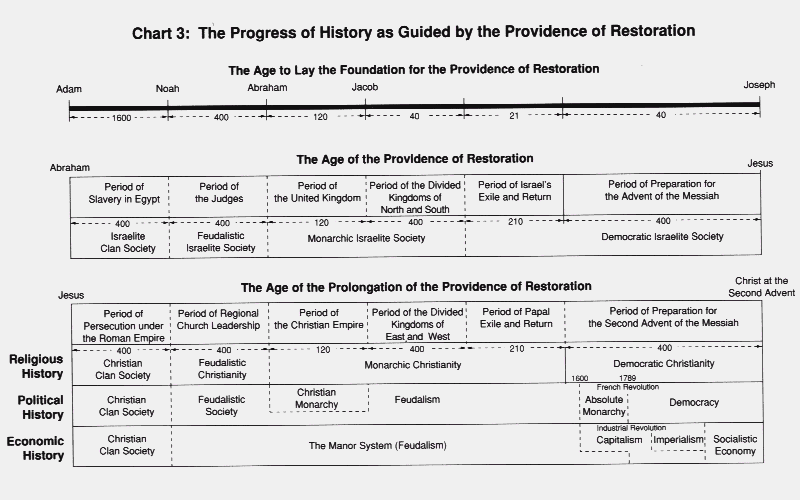
The three stages of the growing period may be classified according to different degrees of manifestation: the formation stage is a manifestation in symbol, the growth stage in image, and the completion stage in substance. Likewise, in the development of history, the parallel periods in the providence of restoration have repeated similar events according to this pattern. Thus,the entire history of the providence of restoration may be divided according to the form of the parallels: the Age of the Providence to Lay the Foundation for Restoration is the age of symbolic parallels, the Age of the Providence of Restoration is the age of image parallels, and the Age of the Prolongation of the Providence of Restoration is the age of substantial parallels.
Next, let us examine the main factors which determine the formation of parallel providential periods. Parallel providential periods recur because of repeated dispensations to restore the foundation for the Messiah. Accordingly, the factors which determine the formation of parallel providential periods are: first, the three conditions necessary for the foundation of faith (the central figure, the object for the condition and the numerical period of indemnity) and second, the indemnity condition to remove the fallen nature, which is necessary to restore the foundation of substance.
Based on these factors, two characteristics of parallel providential periods stand out. First, the lengths of the parallel providential periods are determined based on a fixed number of generations or years of the indemnity period necessary for restoring the foundation of faith. In the providence of restoration, when a central figure has failed to complete his responsibility and caused the prolongation of the Will, God repeats His work through other central figures until the final restoration of the lost foundation of faith is achieved. In each dispensation, the numerical period of indemnity for restoring this foundation must be repeated in some form. For this reason, the parallel periods in history have similar lengths, each representing the same fixed number of years or generations. The purpose of this chapter is to discuss this matter in detail.
Second, the parallels in history are shaped by the other three providential factors: the central figure and the object for the condition offered for the foundation of faith, and the indemnity condition to remove the fallen nature for the foundation of substance. The goal of the providence of restoration is ultimately to restore the foundation for the Messiah. Accordingly, when the providence is prolonged, the various dispensations involved in restoring this foundation are also repeated. Since the foundation for the Messiah can be established only by first laying the foundation of faith through the symbolic offering and then laying the foundation of substance through the substantial offering, providential history has been repeating dispensations to restore these two offerings. These dispensations have shaped the parallels between providential periods. We will elaborate on this matter in the next chapter.

Section 2

THE NUMBER OF GENERATIONS OR YEARS IN THE PERIODS OF THE AGE OF THE PROVIDENCE TO LAY THE FOUNDATION FOR RESTORATION

2.1 WHY AND HOW THE PROVIDENCE OF RESTORATION IS PROLONGED

God’s providence for humankind to lay the foundation for the Messiah, receive the Messiah, and attain the ultimate goal of restoration was prolonged from Adam’s day through the days of Noah, Abraham, Moses and finally to Jesus’ day. When Jesus was killed without accomplishing his ultimate purpose due to the people’s disbelief, the providence of restoration was prolonged again until the time of the Second Coming.
Why has the providence of restoration been prolonged? This question can only be answered with an understanding of the principle of predestination. According to this principle, since God absolutely predestines His Will, He surely will realize it one day. However, whether God’s Will is fulfilled through any particular individual is conditional upon the fulfillment of his portion of responsibility, which is in addition to God’s portion of responsibility. Accordingly, when the Will is not fulfilled because the responsible person fails, God will choose another person in a different era to take his place. God will continue His work until its complete fulfillment, prolonging the providence in the process.
Let us next examine how the providence of restoration has been prolonged. According to the Principle of Creation, God is a being of the number three. All things created in His likeness manifest themselves through a three-stage process with respect to their mode of existence, movement and growth. For any entity to fulfill the purpose of creation by establishing the four position foundation with its spherical motion, it must go through the three stages of origin-division-union action and engage in interaction with three object partners to achieve the three object purpose. The providence to restore the purpose of creation is one of re-creation based on the Word. Therefore, whenever the providence of restoration is prolonged, it may extend to as many as three stages. On the basis of the Principle of Creation, up to three attempts are allowed.
For example, when in Adam’s family Cain and Abel failed to make the substantial offering, the dispensation was repeated in the families of Noah and Abraham, and fulfilled on the third attempt. When Abraham made his mistake in the symbolic offering, the dispensation was prolonged through Isaac and fulfilled by Jacob. The courses to restore Canaan under the leadership of Moses and Jesus each were extended to three courses. When King Saul failed to build the Temple, this dispensation was prolonged through two more kings: David and Solomon. God’s ideal of creation, which was not realized with Adam, has awaited a second and a third providence for its realization: through Jesus, the second Adam, and then through Christ at the Second Advent. Common proverbs, such as the Korean saying “If not accomplished at the first attempt, it surely will be done at the third,” exemplify this aspect of the Principle expressed as everyday wisdom.

2.2 VERTICAL INDEMNITY CONDITIONS AND HORIZONTAL RESTORATION THROUGH INDEMNITY

To inherit and complete the missions of his predecessors in providential history, a central figure responsible for the providence of restoration must fulfill, in a short time, all the indemnity conditions which his predecessors tried to fulfill. If this central figure also fails in his mission, all the indemnity conditions he tried to fulfill are passed down to the next person entrusted with the same responsibility. The conditions which accumulate in the course of providential history due to central figures’ failures to complete their responsibility are called vertical indemnity conditions. The task of the central figure to fulfill all these conditions in a short time is called horizontal restoration through indemnity.
For example, Abraham had to restore horizontally through indemnity all the vertical indemnity conditions which Adam’s family and Noah’s family before him had tried to fulfill. In offering the three sacrifices at one time on the same altar, Abraham was to restore horizontally through indemnity the vertical indemnity conditions accumulated during the three dispensations of the prolonged providence. The three offerings represented all the conditions which Adam and Noah could not fulfill, as well as those which Abraham had to fulfill as the new central figure.
Jacob, in his course, had to fulfill in a short time a condition to horizontally restore through indemnity the vertical indemnity conditions accumulated through the twelve generations since Noah. For this purpose, he was given twelve sons from whom descended the twelve tribes of Israel.
Jesus employed this method to restore horizontally through indemnity all the accumulated vertical indemnity conditions left unfulfilled by the forefathers, prophets and kings who had led the providence during the four thousand years of biblical history until his time. For instance,Jesus chose twelve disciples and seventy followers in order to restore in a short time the vertical indemnity conditions which had accumulated from Jacob’s course, in which God had worked with Jacob’s twelve sons and seventy kinsmen, and from Moses’ course, in which God had worked with the twelve tribes of Israel and seventy elders. Moreover, Jesus fasted for forty days to restore horizontally all the vertical indemnity conditions in the form of dispensations of forty for the separation of Satan, which were required for the foundation of faith. In this sense,we can understand that each central figure in the providence of restoration stands not only for himself as an individual, but represents all the forefathers, prophets and sages who had the same mission in the past. He bears within him the fruits of their labors in history.

2.3 HORIZONTAL RESTORATION THROUGH INDEMNITY CARRIED OUT VERTICALLY

Sometimes horizontal restoration is achieved through a vertical dispensation which may span several generations. This was the case with the providence of restoration in Abraham’s family. By making an acceptable symbolic offering, Abraham was supposed to restore horizontally through indemnity all the vertical indemnity conditions which had accumulated due to the mistakes of Adam’s family and Noah’s family. His mistake in the offering caused yet another failure and delay in the providence. As was explained above, since this was the third attempt in the providence to restore the family foundation for the Messiah, the Principle required that his family accomplish God’s Will without fail. Therefore, in spite of his failure, God sought a way to regard Abraham as if he had not made the mistake, but had restored horizontally the vertical indemnity conditions without any prolongation. To this end, God set up a special dispensation: He had Abraham, Isaac and Jacob fulfill the necessary indemnity conditions while regarding these three individuals as one person with respect to His Will. Therefore, despite this vertical prolongation through three generations, Jacob’s victory and Isaac’s victory became Abraham’s own victory, as if achieved in his generation without any delay.2 The oneness of these three generations is signified by God’s appellation of Himself as “the God of Abraham, the God of Isaac, and the God of Jacob.”3
Thus, God could credit Abraham with having fulfilled, in his own generation, the horizontal indemnity conditions which he had failed to complete, by completing them vertically through the generations of Isaac and Jacob. This type of restoration is called horizontal restoration through indemnity carried out vertically.

2.4 NUMERICAL INDEMNITY PERIODS FOR RESTORING THE FOUNDATION OF FAITH

A central figure has to fulfill one or more numerical indemnity periods in order to restore the foundation of faith.4 Let us examine the reasons for this. God exists upon His Principle, which has a numerical aspect. The universe, with human beings at its center, was created based on numerical principles to be the unfolding of the dual characteristics of the invisible God as His substantial object partner. This is the reason science, which seeks to discover the external laws governing the universe, progresses through research conducted with the aid of mathematics.The first human ancestors were to become complete by passing through a growing period characterized by certain numbers, thus laying the foundation of faith. In their perfection, they were to embody the quality of these numbers. We must investigate these matters because restoration of the foundation of faith requires not only that we offer an object for the condition, symbolizing the universe in bondage to Satan, but also that we pass through a numerical period of indemnity to restore the numbers defiled by Satan.
Based upon what numbers were the first human ancestors, prior to the Fall, to lay the foundation of faith? What numbers were they to have embodied in their perfection? We learned in the Principle of Creation that no entity can exist or thrive without first forming a four position foundation. Accordingly, Adam and Eve in their immaturity had to each form a four position foundation for their existence. Each position in the four position foundation is to pass through the three stages of the growing period, making a total of twelve. Furthermore, each position in the four position foundation accomplishes the three object purpose by taking three object partners, making a total of twelve object partners and fulfilling the twelve object purpose. Hence, the growing period during which Adam was to establish the foundation of faith was a period for fulfilling the number twelve. While in their immaturity, the first human ancestors were to lay the foundation of faith based on the number twelve, and in perfection they were to attain the twelve object purpose and thus embody the quality of the number twelve. Due to their fall, Satan defiled this number. Therefore, a central figure in the providence of restoration must pass through a period of indemnity to restore the number twelve in laying the foundation of faith. Only on that basis can he lay the foundation of substance for the restoration of the perfect embodiment of the quality of the number twelve.
Some examples of the indemnity period to restore the number twelve are: the 120 years it took Noah to build the ark, the 120 years of the providence to restore Canaan under Moses’ leadership, and the 120 years from when Abraham was called by God until Jacob purchased the birthright from Esau for some bread and lentils. As we will discuss below, this last period was to be restored by the 120-year period of the united kingdom in the Old Testament Age, and in the New Testament Age by the corresponding 120-year period of the Christian empire under Charlemagne and his sons.
The maturation process during which Adam and Eve were laying the foundation of faith also required a period to fulfill the number four. They were to pass through the three stages of the growing period and enter the realm of God’s direct dominion, which is the fourth stage. At that point, they would have completed the four position foundation. By thus fulfilling the number four, the first human ancestors were to become its perfect embodiments. Due to the Fall, this number was defiled by Satan. Therefore, central figures in the providence must complete an indemnity period to restore the number four in laying the foundation of faith. Only on that basis can they lay the foundation of substance for the restoration of the perfect embodiment of the quality of the number four.
It was already explained that indemnity periods to restore the number four are necessary to restore the foundation of faith.5 Examples include: Noah’s forty-day flood judgment, Moses’ forty-day fasts, the forty-day mission to spy out the land of Canaan, Jesus’ forty-day fast, and the forty days of the ministry of the resurrected Jesus.
The growing period is also the period to fulfill the number twenty-one. The first human ancestors were to have become the perfect embodiments of the number twenty-one by laying the foundation of faith through a period based on the number twenty-one and then realizing the purpose of creation. However, due to the Fall, this number was defiled by Satan. Hence, central figures in history must complete an indemnity period to restore the number twenty-one in laying the foundation of faith. Only on that basis can they lay the foundation of substance for the restoration of the perfect embodiment of the quality of the number twenty-one.
To understand the significance of the number twenty-one, we should first understand the significance of the numbers three, four and seven in the Principle. God, whose dual characteristics exist in harmonious oneness, is a Being of the number three. The creation is perfected when it attains oneness with God in the four position foundation. Thus, for an individual to become perfect, he must form within himself a four position foundation in which God, the mind and body form a trinity, the center of which is God. For a man and a woman to become a perfect husband and wife, they must build a four position foundation in which they form a trinity with God as their center. For the universe to reach its perfection, it must form a four position foundation in which human beings and the natural world form a trinity with God as their center. Furthermore, for created beings to realize a four position foundation by becoming one centered on God, they must first pass through the three stages of the growing period and complete the three object purpose. For these reasons, the number three is the number of Heaven, or the number of perfection.
When a subject partner and an object partner form a trinity by becoming one centering on God, the resulting union is an individual embodiment of truth which completes the four position foundation. Having thus secured the status of God’s creation, it comes to have position and extension in the four directions: north, south, east and west. In this sense, the number four is the number of the earth.
When a created being passes through the three stages of the growing period and builds the four position foundation, it becomes perfectly established in the qualitative dimensions of time and space, respectively. Thus, every creation becomes the perfect embodiment of the number seven, which is the sum of the number of Heaven and the number of earth. This is the reason why the Bible recounts the creation of heaven and earth as having taken seven days. Just as the period of creation fulfills the number seven, any period for attaining completion may be regarded as a period to fulfill the number seven. Looking at the three stages of the growing period in this manner, the period to complete the formation stage, the period to complete the growth stage, and the period to complete the completion stage are each periods which fulfill the number seven. In total, the entire growing period may be regarded as a period to fulfill the number twenty-one.
Examples of indemnity periods of the number twenty-one include the following: After the flood, God had Noah send out a dove three times to foreshadow His providence, which was to be carried out in three stages. The dove was sent out in seven-day intervals; hence the entire period adds up to twenty-one days.6 When Jacob walked the family course to restore Canaan, he labored in exile in Haran before returning home to Canaan, enduring three seven-year periods which add up to twenty-one years. In the Old Testament Age, there was the 210-year period of the Israelites’ exile in Babylon and their return to Israel, which was to restore through indemnity this twenty-one-year course of Jacob. In the New Testament Age, there was the 210-year period from the papal captivity in Avignon to the eve of the Reformation, which was also to restore through indemnity the twenty-one-year course of Jacob.
The growing period is also the period to fulfill the number forty. The first human ancestors were to perfectly embody the quality of the number forty by laying the foundation of faith based on the number forty and then realizing the purpose of creation. Satan’s attack at the Fall defiled this number. Hence, the central figures in the providence must fulfill an indemnity period to restore the number forty in laying the foundation of faith. Only on that basis can they lay the foundation of substance for the restoration of the perfect embodiment of the quality of the number forty.
To understand how the number forty is fulfilled in the growing period, we must first study the significance of the number ten. If we divide each of the three stages of the growing period into three sub-stages, we arrive at a total of nine levels. Herein lies the significance of the number nine in the Principle. As a numerical unfolding of the dual characteristics of the invisible God, each of God’s creations passes through the nine levels of the growing period. Each then fulfills its purpose of creation when it becomes one with God in the realm of His direct dominion, which constitutes the tenth level. For this reason, we call the number ten the number of unity.God set up the ten generations after Adam to fulfill the indemnity period to restore the number ten before he called upon Noah. By this condition, God wanted to have Noah complete the Will which Adam had left unfinished, and then have him become one with God.
In the four position foundation which Adam and Eve should have established, each position was to pass through the ten levels in their course to maturity, fulfilling in total the number forty. Thus, the course of their maturation was a period to fulfill the number forty, and their four position foundation would have become the perfect embodiment of the number forty.Some examples of indemnity periods of the number forty set up to restore this foundation include: the forty days from the time Noah’s ark came to rest on Mt. Ararat until he sent out the dove, the forty years of Moses’ life in the Pharaoh’s palace, his forty-year exile in the wilderness of Midian, and the forty years in the wilderness during the national course to restore Canaan.
We can deduce that there are two types of periods of the number forty in the providence of restoration. One type is an indemnity period to restore the number four; in restoration, it is multiplied by the number ten, the number of unity, to form forty. The second type is the indemnity period to restore the number forty itself, which Adam should have fulfilled before the Fall, as was just described. The forty years in the wilderness for the national course to restore Canaan was set up to restore both these types of periods of forty at the same time. It restored through indemnity the forty-day spy mission and Moses’ forty-day fast, which were periods to restore the number four. It also restored through indemnity Moses’ forty years in the Pharaoh’s palace and forty years in the wilderness of Midian, which were periods to restore the number forty. Such a phenomenon occurs when the central figure for the foundation of faith is restoring through indemnity horizontally all the vertical indemnity conditions in the history of the providence.
When such a dispensation to horizontally restore periods of the number forty is again prolonged, it can be extended by a rule of multiplication by ten, because the required period of indemnity may have to be expanded through ten stages. Thus, a period of forty years may be expanded to four hundred or even four thousand years. Examples include: the four-hundred-year period from Noah to Abraham, the four hundred years of slavery in Egypt and the four thousand biblical years from Adam to Jesus.
Let us summarize the numerical periods of indemnity a central figure in the providence must fulfill to restore the foundation of faith. Had the first human ancestors not fallen, they would have laid the foundation of faith based on significant numbers, including twelve, four, twenty-one and forty. When they then accomplished the purpose of creation, they would have become the perfect embodiments of the quality of these numbers. Yet due to their fall, all these numbers were claimed by Satan. Therefore, the central figures in providential history must fulfill numerical periods of indemnity to restore the numbers twelve, four, twenty-one and forty before they can restore the foundation of faith. Only on that basis can they lay the foundation of substance for the restoration of the perfect embodiment of the quality of these numbers.

2.5 THE PARALLEL PERIODS DETERMINED BY THE NUMBER OF GENERATIONS

According to the Bible, God chose Noah to shoulder the providence ten generations and sixteen hundred years after Adam. Let us examine what significant numbers were restored by the sixteen hundred years and the ten generations.
The number ten is the number of unity with God. The course of growth to maturity requires a period to fulfill the number ten, through which Adam and Eve were to become the perfect embodiments of the number ten. When this number was defiled by Satan due to their Fall, God sought a central figure in order to restore this number and begin His work to unite the people with Himself by restoring them as perfect embodiments of the quality of the number ten. For this purpose, God would require the central figure to complete an indemnity period to restore the number ten. This is why God called Noah ten generations after Adam.
It was discussed earlier that the first human ancestors were to pass through a course to maturity which fulfilled the number forty and thereby become perfect embodiments of the number forty. For fallen people to become the central figures who will pave the way for the restoration of perfect embodiments of the number forty, they must establish the four position foundation necessary for restoration and then fulfill an indemnity period to restore the number forty. Each position of the four position foundation should fulfill the indemnity period to restore the number forty, yielding an indemnity period to restore the number 160. Moreover, since fallen people were to fulfill this number through ten generations— ten signifying unity with God—they had to complete an indemnity period of the number sixteen hundred. This is the reason the period from Adam to Noah was sixteen hundred years, by biblical reckoning.
After the failure of the providence of restoration in Noah’s family, God waited four hundred years, until another ten generations had elapsed, before calling Abraham to carry the burden of the providence. Set according to the number of generations, the period from Noah to Abraham was parallel to the period from Adam to Noah, and was to restore that earlier period through indemnity.
It was discussed earlier why this period was made four hundred years.7 God had Noah endure the forty-day flood judgment for the purpose of accomplishing the goal of the providence of restoration, which He had pursued by setting up the ten generations and sixteen hundred years. When this forty-day flood judgment was defiled by Satan due to Ham’s mistake, God had to work through another central figure to restore it. From Adam to Noah, God worked to fulfill indemnity periods to restore the number 160 in each of ten generations. In the parallel period of ten generations from Noah to Abraham, God set each generation as the indemnity period to restore the number forty, which is derived from the flood judgment.
The failure of the forty-day flood judgment had to be restored through a period of the number forty. Since the restoration of each subsequent generation had to span its entire length, it could not be fulfilled in only forty days. Hence, God set the indemnity period to be fulfilled by each generation as forty years. A day of the flood was indemnified by a year, just as in Moses’ time when the failure of the forty-day mission to spy out the land was restored through forty years of wandering in the wilderness.8 Since the dispensation in which each generation was set as a forty-year indemnity period continued through ten generations, the entire span of the indemnity period came to be four hundred years.

2.6 PROVIDENTIAL PERIODS OF HORIZONTAL RESTORATION THROUGH INDEMNITY CARRIED OUT VERTICALLY

As explained earlier, each central figure of the providence is called to restore horizontally all the vertical indemnity conditions accumulated up to his time. Hence, the longer providential history is prolonged, the heavier the indemnity conditions will be for the central figures of later generations to fulfill horizontally. In the providence of restoration in Adam’s family, there were as yet no vertical indemnity conditions because the providence had just begun. Therefore, the foundation for the Messiah could have been laid quite simply by Cain and Abel properly making the symbolic offerings and the substantial offering. It would have merely required that once Abel had made his offering in a manner acceptable to God, Cain should have obeyed and followed Abel to fulfill the indemnity condition to remove the fallen nature. In regard to the numerical indemnity periods to restore the foundation of faith, these could have been completed in the short time necessary for making the symbolic and substantial offerings. However, when the providence of restoration was prolonged due to the failure of Adam’s family, vertical indemnity conditions began to accumulate in the form of various numerical indemnity periods. Therefore, in restoring the foundation of faith, the central figures since Adam’s day have had to complete numerical indemnity periods to restore such numbers as twelve, four, twenty-one and forty.
In the case of Noah, he was supposed to restore in his time all of these vertical indemnity conditions. To restore the foundation of faith, he had to go through several numerical indemnity periods: 120 years to build the ark, forty days of the flood judgment, twenty-one days during which he sent out the dove three times at seven-day intervals, and the forty-day period from the time the ark came to rest on Mt. Ararat until he sent out the dove.
Noah faithfully fulfilled these numerical indemnity periods, but due to Ham’s mistake they were invaded by Satan. Consequently, they were again left behind as vertical indemnity conditions. Abraham had the opportunity to restore them all at once through his symbolic offering. However, because Abraham failed in his offering, the indemnity periods could not be restored horizontally. They then had to be restored vertically: by prolonging the fulfillment of His Will through Isaac and Jacob, God worked to fulfill in succession indemnity periods to restore the numbers twelve, four, twenty-one and forty.
In the providence in Abraham’s family, the following indemnity periods, which should have been fulfilled horizontally, were instead carried out in vertical succession to restore the foundation of faith: 120 years from the time Abraham left Haran until Jacob purchased the birthright from Esau with bread and a pottage of lentils; forty years from that time until Jacob was given the blessing of the eldest son by his father Isaac and received God’s blessing on his way to Haran;9 twenty-one years from that time until he completed his toil in Haran and returned to Canaan with his family and wealth;10 and forty years from the time Jacob returned to Canaan until his family entered Egypt at Joseph’s invitation. In this way, the indemnity conditions which could not be restored horizontally were completed as extended vertical periods of fixed lengths.

Section 3

THE PERIODS IN THE AGE OF THE PROVIDENCE OF RESTORATION AND THEIR LENGTHS

The Age of the Providence of Restoration, which was the age of image parallels, was to restore through indemnity the Age of the Providence to Lay the Foundation for Restoration, the age of symbolic parallels. Let us investigate the periods in this age and how their lengths were determined.

3.1 THE FOUR-HUNDRED-YEAR PERIOD OF SLAVERY IN EGYPT

Noah laid the foundation of faith after fulfilling the forty days of the flood judgment for the purpose of separating Satan. When this foundation was shattered due to Ham’s mistake, God tried to raise up Abraham to the same position as Noah by commanding him to make a symbolic offering while standing upon the foundation which had been laid through the intervening period of four hundred years. However, due to Abraham’s mistake, this foundation was defiled by Satan. To recover this foundation of four hundred years, God had the Israelites undergo four hundred years of slavery in Egypt11 and separate Satan once more. The period of slavery in Egypt was the image parallel to the period of sixteen hundred years from Adam to Noah in the age of symbolic parallels. It was to restore that earlier period through parallel indemnity conditions.

3.2 THE FOUR-HUNDRED-YEAR PERIOD OF THE JUDGES

It is recorded that King Solomon began to build the Temple 480 years after the Exodus from Egypt, in the fourth year of his reign.12 Since King Solomon’s reign followed the forty-year reign of King Saul13 and the forty-year reign of King David, we can deduce that there was a period of approximately four hundred years from the time the Israelites entered Canaan until the enthronement of King Saul. This was the period of the judges.
The Israelites under Moses were to secure the foundation of having separated Satan through their slavery in Egypt, thus restoring on the national level the foundation upon which Abraham had stood—the foundation of having separated Satan laid during the four hundred years from Noah to Abraham. However, after they entered Canaan under the leadership of Joshua, Moses’ successor, they again turned faithless, allowing Satan to again defile this foundation of four hundred years. The Israelites needed to undergo another period for the separation of Satan before they could restore this foundation through indemnity. The period of the judges, which ran approximately four hundred years from the time the people entered Canaan until the enthronement of King Saul, was set up for this purpose.
The period of the judges was the image parallel to the period of the four hundred years from Noah to Abraham in the age of symbolic parallels. It was to restore that earlier period through parallel indemnity conditions.

3.3 THE ONE-HUNDRED-AND-TWENTY-YEAR PERIOD OF THE UNITED KINGDOM

The Age of the Providence of Restoration was set up to restore through indemnity the Age of the Providence to Lay the Foundation for Restoration. Therefore, Abraham, who commenced this providential age, was in the position of Adam; Moses was in the position of Noah; and King Saul was in the position of Abraham. Abraham was a transitional figure; he was responsible both to consummate the Age of the Providence to Lay the Foundation for Restoration and to begin the Age of the Providence of Restoration. Abraham was called to lay the family foundation for the Messiah as the basis for the national foundation for the Messiah. God had to lay the family foundation for the Messiah without fail in Abraham’s day because it was His third attempt. Likewise, in King Saul’s day, God was working to establish the national foundation for the Messiah for the third time. Hence, God again had to accomplish this providence without fail.
Due to his mistake in his symbolic offering, Abraham did not restore all at once the conditions inherited from Noah’s course in the form of the various numerical periods necessary to restore the foundation of faith, specifically: 120 years, forty days, twenty-one days and forty days. Therefore, the horizontal restoration of these periods had to be extended vertically. They became successive indemnity periods of 120 years, forty years, twenty-one years and forty years in the generations of Abraham’s family.
King Saul was to restore Abraham’s position on the national level. By building the Temple, King Saul should have restored in a short time all the indemnity conditions in the form of numerical indemnity periods which had been set up to restore the foundation of faith in Moses’ time. These included: 120 years (the three forty-year courses in Moses’ life), forty days (the period of Moses’ fasts), twenty-one days (the first national course to restore Canaan), and forty years (the wilderness course in the national course to restore Canaan). Nevertheless, King Saul was disobedient14 and failed to fulfill God’s Will. As in Abraham’s time, the horizontal restoration of these indemnity periods had to be extended vertically into successive periods: the 120 years of the united kingdom, the four hundred years of the divided kingdoms of north and south, the 210 years of Israel’s exile and return, and the four hundred years of preparation for the advent of the Messiah. After all these periods, the people of Israel were finally ready to receive the Messiah.
The period of the united kingdom was to restore the 120 years of Moses’ life, during which he made three attempts to lay the foundation of faith for the national course to restore Canaan.Let us examine this parallel more closely. After the Israelites had endured four hundred years of slavery to separate Satan, Moses laid the foundation of faith through his forty years in the Pharaoh’s palace. He then tried to lead the people into the land of Canaan, where he was to build the Temple. However, due to the people’s faithlessness, this course was prolonged twice. Moses had to lay the foundation of faith anew through the forty-year course in the wilderness of Midian and again through the forty-year course of wandering in the wilderness. Likewise, Saul was enthroned as the king of Israel after the Israelites had restored the four hundred years of slavery in Egypt through the four-hundred-year period of the judges. During the forty years of his reign, King Saul was to lay the foundation of faith by restoring through indemnity Moses’ forty years of life in the Pharaoh’s palace. He was then to build the Temple. Yet when King Saul became faithless, God’s Will to build the Temple was prolonged through the two forty-year reigns of King David and King Solomon, thus constituting a total of 120 years for the period of the united kingdom.
This period was the image parallel to the period of 120 years in the age of symbolic parallels from the time Abraham left Haran until Jacob purchased the birthright from his brother. It was to restore that earlier period through parallel indemnity conditions. Just as the dispensation which began with Abraham was fulfilled after its prolongation through Isaac and Jacob, God’s dispensation to build the Temple, which began with King Saul, was extended to King David and King Solomon before it was finally fulfilled.

3.4 THE FOUR-HUNDRED-YEAR PERIOD OF THE DIVIDED KINGDOMS OF NORTH AND SOUTH

Had King Saul accomplished the dispensation to build the Temple during the forty years of his reign, among the indemnity periods which he would have restored horizontally was Moses’ forty-day fast, which had been carried out to recover the Word as revealed on the tablets of stone. Once King Saul lost faith, this indemnity period had to be restored as a vertical extension of horizontal restoration. This was the origin of the period of the divided kingdoms of north and south, which lasted nearly four hundred years. It began when the united kingdom was divided into Israel in the north and Judah in the south, and it lasted until the people of Judah were taken into exile in Babylon.
This period was the image parallel to the forty-year period in the age of symbolic parallels, from Jacob’s purchase of the birthright from Esau until he received the blessings of Isaac and God15 and went into Haran. It was to restore that earlier period through parallel indemnity conditions.

3.5 THE TWO-HUNDRED-AND-TEN-YEAR PERIOD OF ISRAEL’S EXILE AND RETURN

The people of the northern kingdom of Israel broke their covenant with God, and as a result, they were taken into captivity by the Assyrians. The people of the southern kingdom of Judah also sinned against God. As a result, they were taken into exile by the Babylonian king, Nebuchadnezzar. After they spent nearly seventy years as captives, Babylon fell to King Cyrus of Persia, who issued a royal decree liberating them. From that time, the Jewish people began a gradual return to Jerusalem and rebuilt the Temple. Ezra the scribe led the last group of returning Jews to Jerusalem, and Nehemiah rebuilt the city wall. Inspired by the prophecy of Malachi,16 the people began preparations to receive the Messiah. This period came to an end approximately 210 years after the Jews were first taken into exile in Babylon and about 140 years after their liberation by the Persians. This was the period of Israel’s exile and return.
Had King Saul accomplished the dispensation to build the Temple, one of the indemnity periods which he would have restored horizontally was the twenty-one-day period when Moses was meant to lead the Israelites from Egypt to Canaan in the first national course. After King Saul lost faith and this dispensation failed, this indemnity period had to be restored as a vertical extension of horizontal restoration. The 210-year period of Israel’s exile and return was set up for this purpose.
This period was the image parallel to the twenty-one-year period in the age of symbolic parallels, which extended from the time Jacob received the blessing of the eldest son from Isaac until he returned to Canaan, and was to restore that earlier period through parallel indemnity conditions. It was to restore three seven-year periods: After arriving in Haran, Jacob worked seven years in order to marry Rachel but was given Leah; he worked seven more years for Rachel; he then worked seven years acquiring wealth before he returned to Canaan.17

3.6 THE FOUR-HUNDRED-YEAR PERIOD OF PREPARATION FOR THE ADVENT OF THE MESSIAH

After the Jewish people returned from exile to their homeland of Israel, they re-established their faith, rebuilt the city wall and, based on Malachi’s prophecy, began as a nation to prepare for the Messiah. From that time until the birth of Jesus was a period of four hundred years, the period of preparation for the advent of the Messiah.
Had King Saul accomplished the dispensation to build the Temple, one of the indemnity conditions he would have restored horizontally through indemnity was the forty years of wandering in the wilderness in the third national course. After King Saul lost faith and this dispensation failed, this indemnity period of forty years had to be restored as a vertical extension of horizontal restoration. The four-hundred-year period of preparation for the advent of the Messiah was set up for this purpose.
This period was the image parallel to the forty-year period in the age of symbolic parallels extending from the time Jacob returned to Canaan until his family entered Egypt at the invitation of his son Joseph. It was to restore that earlier period through parallel indemnity conditions.

Section 4

THE PERIODS IN THE AGE OF THE PROLONGATION OF THE PROVIDENCE OF RESTORATION AND THEIR LENGTHS

The Age of the Prolongation of the Providence of Restoration has been to restore through substantial parallels the Age of the Providence of Restoration, the age of image parallels. As the periods of this age were to restore through indemnity the corresponding periods of the previous age, these periods proceeded in a parallel fashion, both in order and in length.

4.1 THE FOUR-HUNDRED-YEAR PERIOD OF PERSECUTION IN THE ROMAN EMPIRE

Jesus came at the outset of the New Testament Age to complete the Will which had been entrusted to Abraham, the father of faith, who commenced the Old Testament Age. We recall that the Israelites had to endure a four-hundred-year period of slavery in Egypt to restore, on the national level, the foundation of faith which had been shattered due to Abraham’s mistake in the symbolic offering. The early Christians underwent a comparable period of suffering to restore through indemnity the foundation of faith which had been destroyed due to the mistake of the Jewish people, who did not properly follow Jesus as the living sacrifice. This was the four-hundred-year period during which Christians were persecuted in the Roman Empire. The persecution abated by 313 A.D., when the Emperor Constantine formally recognized Christianity as a legal religion. In 392 A.D., the Emperor Theodosius I established Christianity as the state religion. This period was the substantial parallel to the Israelites’ four-hundred-year period of slavery in Egypt, and its purpose was to restore that earlier period through parallel indemnity conditions.

4.2 THE FOUR-HUNDRED-YEAR PERIOD OF REGIONAL CHURCH LEADERSHIP

The next period in the Age of the Providence of Restoration was the four-hundred-year period of the judges, when judges led the Israelite tribes. Since the Age of the Prolongation of the Providence of Restoration has been the age of substantial parallels, it should contain a four-hundred-year period comparable to the period of the judges. What is called the period of regional church leadership began when Christianity was declared the state religion of the Roman Empire and ended with the enthronement of Charlemagne in 800 A.D. In this period, the people were led by regional church leaders—patriarchs, bishops and abbots— with multiple roles corresponding to the judges in Israel. This period was the substantial parallel to the four-hundred-year period of the judges, and its purpose was to restore that earlier period through parallel indemnity conditions.

4.3 THE ONE-HUNDRED-AND-TWENTY-YEAR PERIOD OF THE CHRISTIAN EMPIRE

When the people of Israel unified as a nation under the leadership of King Saul, they began the 120-year period of the united kingdom, which continued through the reigns of King David and King Solomon. The parallel 120-year period of the Christian empire, also called the Carolingian Empire, began with Charlemagne’s enthronement as the emperor in 800 A.D. It ended in 919 A.D. when his royal line ceased in the eastern half of the realm and Henry I was elected king of the German lands. This period was the substantial parallel to the 120-year period of the united kingdom, and its purpose was to restore that earlier period through parallel indemnity conditions.

4.4 THE FOUR-HUNDRED-YEAR PERIOD OF THE DIVIDED KINGDOMS OF EAST AND WEST

Since the Temple’s holiness was not properly upheld in the period of the united kingdom, the kingdom was eventually divided into two kingdoms: Israel in the north and Judah in the south. Thus began the four-hundred-year period of the divided kingdoms of north and south. In the Age of the Prolongation of the Providence of Restoration, the Carolingian Empire was divided into two kingdoms: the Holy Roman Empire in the east and France in the west.Although when the Carolingian Empire was first divided, it was split into the kingdoms of the East Franks, the West Franks and Italy, Italy soon reverted to the rule of the East Franks and together these constituted the Holy Roman Empire, while the West Franks consolidated as the Kingdom of France. This four-hundred-year period of the divided kingdoms of east and west began with the division of the Christian empire in 919 and ended in 1309, when the papacy moved to Avignon, in what is now southern France. This period was the substantial parallel to the four-hundred-year period of the divided kingdoms of north and south, and its purpose was to restore that earlier period through parallel indemnity conditions.

4.5 THE TWO-HUNDRED-AND-TEN-YEAR PERIOD OF PAPAL EXILE AND RETURN

During the period of the divided kingdoms of north and south, the kingdom of Israel in the north perished at the hands of the Assyrians because its people had fallen into corruption and idolatry. The kingdom of Judah in the south also became faithless and failed to uphold the holiness of the Temple; consequently, its people were taken into exile in Babylon, the satanic world. Over the next 210 years, they suffered in exile, returned to Israel, rebuilt the Temple, and renewed the covenant. The parallel period of papal exile and return also lasted approximately 210 years. It began in 1309 A.D. when, the papacy having become corrupt, Pope Clement V was forced to move the papacy from Rome to Avignon and live there subject to the kings of France. This period continued even after the papacy returned to Rome until the Protestant Reformation began in 1517. This period of 210 years was the substantial parallel to the 210-year period of Israel’s exile and return, and its purpose was to restore that earlier period through parallel indemnity conditions.

4.6 THE FOUR-HUNDRED-YEAR PERIOD OF PREPARATION FOR THE SECOND ADVENT OF THE MESSIAH

After the Jewish people were liberated from their exile in Babylon and returned to Jerusalem, they reformed their religious and political life. Based on the prophecies of Malachi, they began preparations to receive the Messiah. After the four-hundred-year period of preparation for the advent of the Messiah, Jesus came to the Jewish people. To restore that period through indemnity in the Age of the Prolongation of the Providence of Restoration, we expect a parallel four-hundred-year period of preparation for the Second Advent of the Messiah. In fact, it began in 1517 with Martin Luther and the Protestant Reformation and has lasted until the eve of the Second Advent of Christ on the earth. As the substantial parallel to the four-hundred-year period of preparation for the advent of the Messiah, its purpose has been to restore that earlier period through parallel indemnity conditions.
Parallel Providential Periods in God's Work
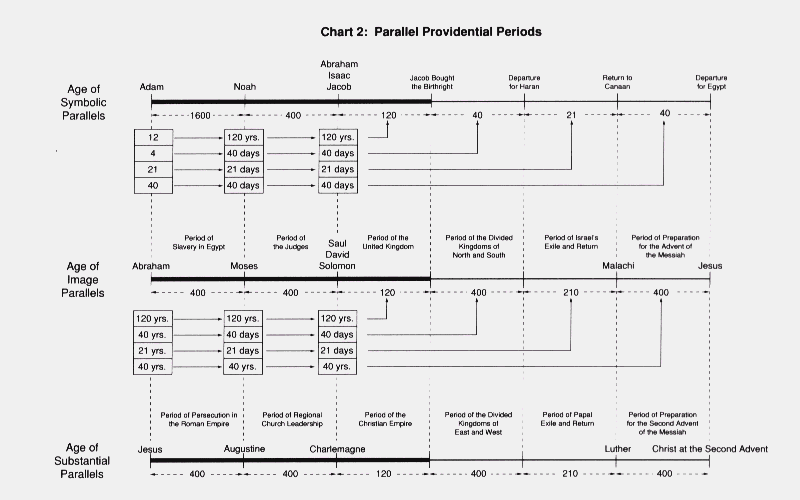
Chart 2: Parallel Providential Periods
Parallel Providential Periods in God's Work

The Parallels of History: Why historic periods in the Bible repeat

Parallels of History, History, God's Work, God's Will, Foundation for the Messiah, Jewish History, History of Christianity
Exposition of the Divine Principle
1996 Translation

Chapter 4

The Parallels between the Two Ages
in the Providence of Restoration


Part II – Chapter 4 | The Parallels between the Two Ages in the Providence of Restoration

Since the ultimate purpose of the providence of restoration is to lay the foundation for the Messiah, if it is prolonged, the dispensations to restore this foundation must be repeated. We know that to establish the foundation for the Messiah, a central figure must make a symbolic offering acceptable to God by employing an object for the condition and passing through a required time period. In addition, he must lay the foundation of substance by making an acceptable substantial offering upon fulfilling the indemnity condition to remove the fallen nature. In the course of the providence, the repetition of dispensations to restore the foundation for the Messiah has meant, in effect, the repetition of dispensations to restore through indemnity the symbolic offering and the substantial offering. The historical record illuminates the parallels between providential periods caused by the repetition of dispensations to restore through indemnity the foundation for the Messiah. The Age of the Prolongation of the Providence of Restoration has been set up to restore the Age of the Providence of Restoration through parallel indemnity conditions of a substantial type. Let us examine the comparable characteristics of each providential period from this standpoint.
First, however, we need to identify what groups of people have had the central responsibility for God’s providence and the historical sources which can shed light on their history. Human history consists of the histories of countless peoples. Nevertheless, God has specially chosen certain people to walk the model course of restoration to lay the foundation for the Messiah. God puts them at the center of His providence and guides them by His Principle. Their history, in turn, steers the course of human history as a whole. A nation or people entrusted with such a mission is called God’s chosen people.
God’s first chosen people consisted of the descendants of Abraham, Isaac and Jacob, who had established the family foundation for the Messiah. Therefore, the nation centrally responsible for God’s providence in the Age of the Providence of Restoration was Israel. The Old Testament, which records the history of Israel, provides the source material with which to study the history of the providence in that age.
However, from the time that they rejected Jesus, the Jewish people lost their qualification to be centrally responsible for God’s providence. Foreseeing this, Jesus uttered the parable of the vineyard, saying:
The kingdom of God will be taken away from you and given to a nation producing the fruits of it. —Matt. 21:43
St. Paul said in anguish over his kinsmen, the Jewish people:
For not all who are descended from Israel belong to Israel, and not all are children of Abraham because they are his descendants . . . it is not the children of the flesh who are the children of God, but the children of the promise are reckoned as descendants. —Rom. 9:6-8
Indeed, the people who became centrally responsible for the providence in the Age of the Prolongation of the Providence of Restoration were not the Jews, but rather the Christians. They assumed the mission to accomplish God’s unfulfilled providence of restoration. Accordingly, the history of Christianity provides the source material for understanding providential history in this age. In this sense, the descendants of Abraham in the Old Testament Age may be referred to as the First Israel, and the Christians in the New Testament Age may be called the Second Israel.1
When we compare the Old Testament to the New Testament, the five books of the Law (Genesis to Deuteronomy), the twelve books of history (Joshua to Esther), the five books of poetry and wisdom (Job to the Song of Solomon) and the seventeen books of prophecy (Isaiah to Malachi) in the Old Testament correspond to the Gospels, Acts, the Letters of the Apostles and Revelation, respectively. However, while the books of history in the Old Testament record most of the two-thousand-year history of Israel, the Book of Acts records only the history of the earliest Christians in the generation after Jesus’ death. To find historical records pertaining to God’s work of restoration in the New Testament Age with a scope comparable to those found in the Old Testament, we must consult in addition the entire history of Christianity from Jesus’ time to the present day. On this basis, we can compare the histories of the First and Second Israels and their impact on the character of each period in the two providential ages. Recognizing a pattern of parallel periods, we come to know more clearly that history has been shaped by the systematic and lawful providence of the living God.

Section 1

THE PERIOD OF SLAVERY IN EGYPT AND THE PERIOD OF PERSECUTION IN THE ROMAN EMPIRE

After Jacob entered Egypt with his twelve sons and seventy kinsmen, their descendants suffered terrible abuse at the hands of the Egyptians for four hundred years. This was for the restoration of the four-hundred-year period from Noah to Abraham—a period for the separation of Satan—which had been defiled due to Abraham’s mistake in his offering. The corresponding period of persecution in the Roman Empire was to restore this previous period through parallel indemnity conditions. Jesus’ twelve apostles and seventy disciples were the first of many generations of Christians who suffered severe persecution in the Roman Empire over a period of four hundred years. By enduring this suffering, they were restoring through indemnity the four-hundred-year period of preparation for the advent of the Messiah—a period for the separation of Satan—which had been defiled due to the Jewish people’s mistake in not honoring Jesus as a living sacrifice but leading him to the cross.
In the period of slavery in Egypt, the chosen people of the First Israel kept themselves pure by circumcision,2 by making sacrifices3 and, as they left Egypt, by keeping the Sabbath.4During the period of persecution in the Roman Empire, the Christians as the Second Israel lived a life of purity by performing the sacraments of baptism and holy communion, offering themselves as sacrifices, and keeping the Sabbath. In both periods, the chosen people had to follow this way of pure faith to separate Satan, who was constantly assailing them due to the condition of previous mistakes by Abraham and the Jewish people.
At the end of Israel’s slavery in Egypt, Moses brought the Pharaoh to his knees by the power of the three signs and ten plagues. He then led the Israelites out of Egypt and set out for the land of Canaan. Likewise, toward the end of the period of persecution in the Roman Empire, after Christians had drunk the cup of persecution to the fill, Jesus increased the numbers of believers by moving their hearts with his power and grace. By stirring the heart of Emperor Constantine, Jesus led him to recognize Christianity in 313 A.D. Jesus inspired Theodosius I in 392 A.D. to establish Christianity as the state religion. Christians thus restored Canaan spiritually inside the Roman Empire, the satanic world. In the Old Testament Age, God worked through the external indemnity conditions set by the Mosaic Law; likewise, God had Moses defeat the Pharaoh through the external power of miracles. In the New Testament Age, when God worked through the internal indemnity conditions of faith, He manifested His power internally by moving the hearts of people.
When the period of slavery in Egypt was over, Moses on Mt. Sinai received the Ten Commandments and God’s Word revealed in the Law, which formed the core of the Old Testament Scriptures. By setting up and honoring the tablets of stone, the Ark of the Covenant and the Tabernacle, he paved the way for the Israelites to prepare for the coming of the Messiah. Likewise, at the conclusion of the period of persecution in the Roman Empire, Christians gathered the writings which had been left behind by the apostles and evangelists and established the canon of the New Testament. Based on these writings, they sought to realize God’s ideals spiritually, ideals which had been enshrined in the Ten Commandments and the Tabernacle in the Old Testament Age. They built up churches and expanded their foundation to prepare for the Second Coming of Christ. After Jesus’ ascension, the resurrected Jesus and the Holy Spirit guided Christians directly. Hence, God did not raise up any one person as the central figure responsible for His entire providence, as He had earlier.

Section 2

THE PERIOD OF THE JUDGES AND THE PERIOD OF REGIONAL CHURCH LEADERSHIP

Upon inheriting the mission of Moses, Joshua led the Israelites into the land of Canaan. For the next four hundred years, fifteen judges governed the Israelite tribes: thirteen judges from Othniel to Samson recorded in the Book of Judges, as well as Eli and Samuel. The judges filled the various responsibilities of prophet, priest and king, which became separate offices in the later periods. Israel in this period was a feudalistic society with no central political authority. In the New Testament Age, the period of regional church leadership was set up to restore the period of the judges through parallel indemnity conditions. In this period, regional church leaders—patriarchs, bishops and abbots—led Christian society. Like the judges of the Old Testament Age, they had duties similar to those of prophet, priest and king. As in the time of the judges, Christian society in this period was a feudalistic society under these local authorities.
In the age before Jesus, when God was working with the First Israel to establish a national foundation for the Messiah both spiritually and physically, politics, economy and religion tended to have a national focus. On the other hand, in the age after Jesus, Christians were building a spiritual kingdom under the leadership of Jesus, who stood upon the spiritual foundation for the Messiah. Their loyalty transcended national barriers, for they were serving the resurrected Jesus as the King of Kings. Therefore, the spiritual kingdom of Jesus was not confined to any one nation, but expanded to the far-flung corners of the globe.
The period of the judges began after the Israelites were liberated from slavery in Egypt and the younger generation united solidly under the leadership of Joshua and Caleb to enter the land of Canaan. They parceled out the territory among their clans and tribes. Settling in villages united around the judges, the people consolidated into a chosen nation and established a simple feudalistic society. Likewise, the period of regional church leadership in the Christian era began after the liberation of Christianity from the persecution of the Roman Empire, the satanic world. Christians spread the Gospel to the Germanic peoples, many of whom had migrated to Western Europe in the fourth century to escape the invading Huns. In their new land of Western Europe, God raised up the Germanic tribes as a new chosen people and established an early form of feudal society, which later matured into the feudalism of the Middle Ages.
As we discussed earlier, when the Israelites set out for Canaan, they first built the Tabernacle as the symbol of the Messiah and the object for the condition to decide who would stand in the position of Abel for the foundation of substance.5 In the period of the judges, the Israelites should have exalted the Tabernacle and remained obedient to the direction of the judges. However, instead of destroying the seven Canaanite tribes, the Israelites lived among them and were influenced by their customs. They even took to worshipping their idols, thus bringing great confusion to their faith. Likewise, in the period of regional church leadership, the Christians were supposed to exalt the Church, which was the image of the Messiah, and follow the directions of its bishops and monastic leaders. The Church was the object for the condition to determine who would have the position of Abel. However, they became influenced by the religion and culture of the pagan Germanic tribes, which brought great confusion to the Christian faith.

Section 3

THE PERIOD OF THE UNITED KINGDOM AND THE PERIOD OF THE CHRISTIAN EMPIRE

When the period of the judges came to a close and the First Israel entered the period of the united kingdom, the functions of the judge were apportioned to the offices of prophet, priest and king. The prophets received instructions directly from God, the priests kept charge over the Tabernacle and later the Temple, and the king governed the nation. Each carried on their distinct missions in guiding Israel to accomplish the goal of the providence of restoration. The purpose of the period of the Christian empire was to restore the period of the united kingdom through parallel indemnity conditions. Thus, when the period of regional church leadership came to a close, the missions of these leaders were apportioned to the offices of monastic leaders corresponding to the prophets, the pope corresponding to the high priest, and the emperor, who ruled the people. They were responsible to guide the Second Israel to accomplish the goal of the providence of restoration. In the previous period, the Christian Church had been divided into the five patriarchates of Jerusalem, Antioch, Alexandria, Constantinople and Rome, with Rome dominant in the West. The pope, as the Roman patriarch was called, supervised all the bishops and abbots in Western Europe.
In the period of the united kingdom, the kings established the kingdom of Israel around the Temple, thereby manifesting the ideal of Moses’ Tabernacle which was first conceived at the time of the Exodus. This was the image course for building the Kingdom of Heaven ruled by Jesus, which he would one day come to establish as the King of Kings.6 Likewise, in the period of the Christian empire, Charlemagne’s empire realized the ideal of the Christian state as set down in The City of God by St. Augustine—who lived when the Christians had just been liberated from the oppression of the Roman Empire, a time parallel to that of Moses. Once again, this was the image course for building the Kingdom of God, which Christ, as the King of Kings, will one day return to establish. Accordingly, in this period, the emperor and the pope were to realize the ideal Christian state by uniting wholeheartedly to follow the Will of God. The spiritual kingdom ruled by the pope, which had been founded upon the spiritual foundation for the Messiah, and the temporal kingdom ruled by the emperor should have united based on Christ’s teachings. Had they done so, religion, politics and economy would have harmonized, and the foundation for the Second Advent of Christ would have been established at that time.
In the period of the united kingdom of Israel, the king was the central figure for restoring the foundation of faith. He was responsible to carry out the Word of God, which was given through the prophets. Before the king was anointed, the prophet and the high priest were to represent and teach the Word of God, and thus they stood in the position of Abel. Their mission, as required by the providence of restoration, was to restore the physical world from the position of the archangel, representing the spirit world. However, after they laid the foundation upon which the king could stand, and anointed and blessed him as the king, they were to take the role of Cain before him. The king was to rule his kingdom according to the guidance of the prophets, and the prophets were to obey the king as his subjects and counselors.
About eight hundred years after Abraham’s descendants entered Egypt, by God’s command the prophet Samuel anointed Saul as the first king of Israel.7 King Saul stood upon the foundation of the four hundred years under the judges. Had he completed the forty years of his reign in accordance with God’s desires, he would have stood in the position of having restored through indemnity the four hundred years of slavery in Egypt and Moses’ forty years in the Pharaoh’s palace. Thereupon, King Saul would have fulfilled the dispensation of forty for the separation of Satan and laid the foundation of faith. If, upon this foundation, King Saul had built and exalted the Temple, the image of the Messiah, he would have then stood in the position Moses should have occupied had he not failed in the first national course to restore Canaan, but had built the Temple in Canaan and glorified it. If the Israelites had then stood upon this foundation of faith and faithfully followed King Saul as he honored the Temple, they would have laid the foundation of substance. The foundation for the Messiah would have been established at that time.
However, because King Saul disobeyed the commands of God given through the prophet Samuel,8 he was in no position to build the Temple. Upon his failure, King Saul found himself in the same position as Moses after he had failed in the first national course to restore Canaan.As was the case with Moses, the providence of restoration through King Saul was extended. Forty years of King David’s reign and forty years of King Solomon’s reign would pass before the foundation of faith was laid and the Temple built. Furthermore, as we discussed earlier, King Saul was also in the position of Abraham. In the same manner that the Will entrusted to Abraham was finally brought to pass through Isaac and Jacob, God’s Will to build the Temple through King Saul had to be continued through the reign of King David and was finally realized during the reign of King Solomon. Nevertheless, King Solomon left the position of Abel for the substantial offering when he fell into lust with his many foreign wives, who turned him away from God.9 Hence, there was no way for Israel to establish the foundation of substance. The foundation for the Messiah, which should have been laid in the period of the united kingdom, was not realized.
In the period of the Christian empire, all the conditions pertaining to the united kingdom had to be restored through parallel conditions of indemnity. Once again, the central figure to restore the foundation of faith was the emperor. He was responsible to actualize the Christian ideals set forth by the leading monastics and the pope. The pope, for his part, stood in a position comparable to the high priest of Israel, who received God’s commands through the prophets. He was responsible to lay the spiritual foundation upon which the emperor could realize the ideal Christian state. After crowning and blessing the emperor, the pope was to obey him as one of his subjects in temporal matters. The emperor, in turn, was to lift up and further the spiritual work of the papacy in his realm.
Pope Leo III crowned Charlemagne and blessed him as the first emperor of Christendom in 800 A.D. Charlemagne stood upon the foundation of the four-hundred-year period of regional church leadership, which restored through indemnity, in the form of substantial parallels, the four-hundred-year period of the judges. Therefore, like King Saul, he stood upon the foundation of a dispensation of forty for the separation of Satan. By faithfully living according to the teachings of Jesus in his work to realize the Christian ideal of the state, he was to establish the foundation of faith. Indeed, when Charlemagne was crowned emperor, he achieved this foundation. Had the Second Israel absolutely believed in and followed Charlemagne, the foundation of substance would have been laid, and thereby the foundation for the Messiah would have been established. In other words, the spiritual kingdom led by the pope and the earthly kingdom led by the emperor were to fully unite upon the existing spiritual foundation for the Messiah. Christ would then have returned upon this solid ground and built his Kingdom.However, the emperor did not remain obedient to God’s Will and left the position of Abel for the substantial offering. Neither the foundation of substance nor the foundation for the Second Advent of the Messiah was established.

Section 4

THE PERIOD OF THE DIVIDED KINGDOMS OF NORTH AND SOUTH AND THE PERIOD OF THE DIVIDED KINGDOMS OF EAST AND WEST

Because King Solomon was led by his wives and concubines to worship idols, the united kingdom of Israel was divided upon his death, having lasted only three generations.10 The kingdom of Israel in the north, which was founded by ten of the twelve tribes, was in the position of Cain, while the kingdom of Judah in the south, which was founded by the two remaining tribes, was in the position of Abel. This was how the period of the divided kingdoms of north and south began.
The Christian empire also began to divide in the third generation. Charlemagne’s grandsons partitioned it into three kingdoms: the East Franks, the West Franks and Italy. The descendants of Charlemagne were in bitter and constant conflict with each other. The remnants of the Christian empire soon coalesced into two kingdoms, with Italy reverting to the rule of the East Franks. The kingdom of the East Franks flourished greatly under Otto I and came to be called the Holy Roman Empire. Claiming to be the heir of the Roman Empire, it ruled parts of Western Europe and sought to secure dominion over both politics and religion. The Holy Roman Empire stood in the position of Abel in relation to France, as the kingdom of the West Franks came to be called.
The northern kingdom of Israel was founded by Jeroboam, who had lived in exile in the days of King Solomon. It was ruled by nineteen kings over some 210 years. Through repeated assassinations, its short-lived royal families changed nine times; not one king was righteous in the sight of God. Nevertheless, God sent the prophet Elijah, who prevailed in the contest with 850 prophets of Baal and Asherah on Mt. Carmel when God sent down fire upon the altar.11Other prophets, including Elisha, Jonah, Hosea and Amos, spread the Word of God at the risk of their lives. Yet since the northern kingdom continued to worship foreign gods and did not repent, God had the Assyrians destroy them and took away their qualification as the chosen people forever.12
The southern kingdom of Judah was established by Solomon’s son, Rehoboam. Its royal house continued in one dynastic line from David to Zedekiah, producing many righteous kings out of the twenty who ruled the kingdom for its nearly four hundred years of existence. Nevertheless, a succession of evil kings, combined with influence from the northern kingdom, led to much idolatry and corruption. Consequently, the people of the southern kingdom were taken into exile in Babylon.
In the period of the divided kingdoms of north and south, whenever the Israelites violated their covenant with God, straying from the ideal of the Temple, God sent many prophets—such as Elijah, Isaiah and Jeremiah—to admonish them and move them to repentance and internal reform. However, because the kings and the people did not heed the warnings of the prophets and did not repent, God chastised them externally by sending gentile nations such as Syria, Assyria and Babylon to attack them.
During the parallel period of the divided kingdoms of east and west, the papacy was corrupt. God sent prominent monks such as St. Thomas Aquinas and St. Francis of Assisi to admonish the papacy and promote internal reform in the Church. Since the papacy and the Church did not repent, but sank further into corruption and immorality, God chastised them externally by letting their people fight the Muslims. This was the providential reason behind the Crusades. While Jerusalem and the Holy Land were under the protection of the Abbasid Caliphate, Christian pilgrims were received with hospitality. After the Caliphate collapsed and the Holy Land was conquered by the Seljuk Turks, cries of alarm went out that Christian pilgrims were being harassed. Outraged, the popes raised the Crusades to recover the Holy Land. There were eight Crusades, beginning in 1095 and continuing sporadically for about two hundred years. Despite some initial success, the Crusaders were defeated again and again.
The period of the divided kingdoms of north and south came to an end when gentile nations took the people of Israel and Judah into exile. They put an end to the monarchy in Israel. Likewise, at the close of the period of the divided kingdoms of east and west, the papacy had completely lost its prestige and credibility after the repeated defeats of the Crusades. Christianity thus lost its center of spiritual sovereignty. Moreover, since the lords and knights who had maintained feudal society were decimated by the Crusades, feudal society lost its political power and vigor. Since the papacy and the feudal lords had spent enormous funds to pursue these unsuccessful wars, they were left impoverished. Monarchic Christianity began to erode.

Section 5

THE PERIOD OF ISRAEL’S EXILE AND RETURN AND THE PERIOD OF THE PAPAL EXILE AND RETURN

By falling into faithlessness without repentance, the people of Israel failed to realize the ideal of God’s nation founded upon the Temple. To make another attempt at fulfilling this Will,God had the people suffer hardships as exiles in Babylon. This was similar to when God had the Israelites suffer as slaves in Egypt to restore through indemnity Abraham’s mistake in the symbolic offering.
In the period of the Christian empire, God worked through the pope and the emperor to establish a kingdom prepared for Christ at his Second Coming. God’s intention was that ultimately they would bequeath the empire and the throne to the Messiah when he would come as the King of Kings and build God’s kingdom13 upon that foundation. Yet the emperors and popes became corrupt and did not repent. The popes did not lay the spiritual foundation upon which the emperors could stand as the central figures for the foundation of substance. Therefore, the foundation for the Second Advent of Christ was not established. To begin a new dispensation to restore this foundation, God allowed the popes to be taken into exile and suffer captivity.
In the earlier parallel period, nearly seventy years elapsed from the time King Nebuchadnezzar of Babylon took into captivity King Jehoiachin and his royal family, as well as prophets including Daniel and Ezekiel, priests, officials, craftsmen and many other Israelites, until the fall of Babylon and their liberation by the royal decree of King Cyrus.14 It then took another 140 years for the exiles to return to their homeland in three waves, until they fully reformed themselves as a nation united around the Will of God as proclaimed in the messianic prophecies of Malachi. Henceforth, they began to prepare for the coming of the Messiah. In the period of papal exile and return, which was to restore this period through indemnity in the form of substantial parallels, Western Christianity had to walk a similar course.
The popes and priests, sunk in immorality, gradually lost the confidence of the people. The authority of the papacy sank even lower due to the repeated defeats of the Crusades. The end of the Crusades saw the gradual collapse of the feudal system in Europe and the emergence of modern nation-states. As the power of secular monarchies grew, the conflict between the popes and the kings escalated. In one such conflict, King Philip IV, “the Fair,” of France imprisoned Pope Boniface VIII for a time. In 1309, Philip forced Pope Clement V to move the papacy from Rome to Avignon in southern France. For seventy years, successive popes lived there subject to the kings of France, until 1377 when Pope Gregory XI returned the papal residence to Rome.
After Gregory’s death, the cardinals elected an Italian, the Archbishop of Bari, as Pope Urban VI. However, a group of cardinals, mostly Frenchmen, rejected him, elected another pope, Clement VII, and established a rival papacy in Avignon. The Great Schism continued into the next century. To resolve this impasse, the cardinals from both camps held a council in Pisa, Italy, in 1409, which dismissed both the Roman and Avignon popes and appointed Alexander V as the legitimate pope. The two popes, however, refused to resign, creating for a short time the spectacle of three contending popes. Shortly afterwards, cardinals, bishops, theologians, royalty and their envoys gathered for the General Council of Constance (1414-1417). It dismissed all three popes and elected Martin V as the new pope, effectively ending the Great Schism.
The Council of Constance insisted that the general councils of the Church had supreme authority, greater than that of the pope and with the power to elect or depose him, and directed that subsequent councils be held at regular intervals. Thus, it sought to reorganize the Roman church as a constitutional monarchy. However, in 1431, when delegates gathered for the next council, held in Basel, Switzerland, the pope tried to adjourn the meeting. The delegates refused to leave and carried on in the pope’s absence, but to no effect; in 1449, they finally disbanded. The plan to institutionalize a constitutional monarchy within the Roman church came to naught, and the papacy recovered the authority it had lost in 1309.
The leaders of the conciliar movement in the fifteenth century had tried to reform the corrupt papacy by setting up a representative council composed of bishops and laymen and giving it supreme authority. Nevertheless, the papacy ended up reasserting its full authority, as it had not enjoyed since before its exile. Furthermore, these councils condemned more fundamental reforms as promoted by John Wycliffe (1330-1384) and Jan Hus (1373-1415), who was personally invited to attend the Council of Constance only to be burned at the stake. At that point, the die was cast for the outbreak of the Protestant Reformation.
This period of approximately 210 years ran from 1309, with the papacy’s seventy years of exile in Avignon, through the Great Schism, the conciliar movement and the restoration of papal authority in the Roman church, to the eve of the Protestant Reformation spearheaded by Martin Luther in 1517. Its purpose was to restore through indemnity, in the form of substantial parallels, the 210-year period of Israel’s exile and return—from Israel’s seventy years of exile in Babylon through the stages of the returning to Israel and the rebuilding of the Temple, until the reform of politics and religion under the leadership of Ezra, Nehemiah and the prophet Malachi.

Section 6

THE PERIOD OF PREPARATION FOR THE ADVENT OF THE MESSIAH AND THE PERIOD OF PREPARATION FOR THE SECOND ADVENT OF THE MESSIAH

Following the period of Israel’s exile and return, another four hundred years elapsed before Jesus came. This was the period of preparation for the advent of the Messiah. Likewise, Christianity is to meet Christ at his Second Advent only after passing through four hundred years of the period of preparation for the Second Advent of the Messiah, which has followed the period of papal exile and return. It should restore through indemnity in the form of substantial parallels the period of preparation for the advent of the Messiah.
During the four thousand years of God’s providence of restoration from Adam to Jesus, vertical indemnity conditions had accumulated due to Satan’s repeated defilement of dispensations to restore the foundation of faith through periods of forty for the separation of Satan. The period of preparation for the advent of the Messiah was intended to be the final period of providential history in which all these conditions would be horizontally restored through indemnity. Likewise, the period of preparation for the Second Advent of the Messiah is intended to be the final period of providential history, when all the vertical indemnity conditions which have accumulated during the six-thousand-year history of the providence of restoration since Adam’s day are horizontally restored.
Upon returning from the Babylonian exile, the Israelites established the foundation of faith by repenting of their past sin of idolatry, rebuilding the Temple15 which had been destroyed by King Nebuchadnezzar, and reforming their faith based on the Mosaic Law under the guidance of Ezra the scribe.16 They then began to prepare for the coming of the Messiah according to the word of the prophet Malachi. Likewise, after the papacy’s return to Rome, medieval Christians established the foundation of faith by seeking to reform the Roman church; these efforts culminated in the Protestant Reformation led by Martin Luther. This movement pierced the gloom of medieval Europe with the light of the Gospel and pioneered new paths of faith.
One purpose of the period of preparation for the advent of the Messiah was to restore through indemnity in the form of image parallels the approximately forty years of Jacob’s preparation to enter Egypt. This was the period in his life from his return to Canaan from Haran until he and his family entered Egypt. The period of preparation for the Second Advent of the Messiah is to restore this period through indemnity in the form of substantial parallels. Accordingly, Christians in this period have had to suffer tribulations and hardships as Jacob’s family did until they met Joseph in Egypt, or as the Jews did before they met Jesus.Specifically, in the Age of the Providence of Restoration, people were justified before God by such external conditions as keeping the Mosaic Law and offering sacrifices. Therefore, during the period of preparation for the advent of the Messiah, the First Israel had to suffer external hardships at the hands of the gentile nations of Persia, Greece, Egypt, Syria and Rome. During the Age of the Prolongation of the Providence of Restoration, Christians have been justified before God by internal conditions of prayer and faith according to the teachings of Jesus. Hence, in the period of preparation for the Second Advent of the Messiah, the Second Israel has had to walk a path of internal tribulations. The ideologies of Renaissance humanism and the Enlightenment, as well as the call for religious freedom which arose from the Reformation, have created a profusion of philosophies and theologies, causing great confusion in the Christian faith and turmoil in people’s spiritual lives.
The period of preparation for the Second Advent of the Messiah has also been restoring, through parallel indemnity conditions of a substantial type, the internal preparations and external environment for the worldwide reception of the Messiah, which had first been set up during the four hundred years of the period of preparation for the advent of the Messiah.
In preparation for the First Coming of Christ, God sent the prophet Malachi to the chosen people 430 years beforehand to arouse in them a strong messianic expectation. At the same time, God encouraged the Jews to reform their religion and deepen their faith to make the internal preparations necessary to receive the Messiah. Meanwhile, among the world’s peoples, God founded religions suited to their regions and cultures by which they could make the necessary internal preparations to receive the Messiah. In India, God established Buddhism through Gautama Buddha (565-485 B.C.) as a new development out of Hinduism. In Greece, God inspired Socrates (470-399 B.C.) and opened the brilliant age of classical Greek civilization. In the Far East, God raised up Confucius (552-479 B.C.), whose teachings of Confucianism established the standard of human ethics. Jesus was to come upon this worldwide foundation of preparation, and through his teachings he was to bring together Judaism, Hellenism, Buddhism and Confucianism. He was to unify all religions and civilizations into one worldwide civilization founded upon the Christian Gospel.
Since the Renaissance, God has been creating the religious, political and economic environment conducive to the work of Christ at his Second Coming. This has been the age to restore through indemnity, in the form of substantial parallels, the earlier period when God had set up the worldwide environment to prepare for the coming of Jesus. Beginning with the Renaissance, progress in virtually every field of human endeavor, including politics, economy, culture and science, has increased at a rapid rate. Today, these fields have reached their zenith and have created a global environment conducive to the work of Christ at his Second Coming. In Jesus’ day, the Roman Empire ruled the vast domains around the Mediterranean Sea, integrated by an advanced and extensive transportation system reaching out in all directions. This was the center of a vast Hellenistic civilization founded on the Greek language. Thus, all the necessary preparations had been made for a swift transmission of the teachings of the Messiah from Israel, where Jesus lived, to Rome and the world. Similarly, in the present era of the Second Advent, the influence of the Western powers has expanded the democratic political sphere throughout the world. The rapid progress of transportation and communication has greatly bridged the gap between East and West, and the extensive contact among languages and cultures has brought the world much closer together. These developments characterize an environment in which the teachings of the returning Christ can freely and swiftly be conveyed to the hearts of all humankind. This will enable his teachings to bring rapid and profound changes all over the globe.

Section 7

THE PROVIDENCE OF RESTORATION AND THE PROGRESS OF HISTORY

The Kingdom of Heaven on earth is a society whose structure is formed in the image of a perfect person.17 Likewise, fallen society may be regarded as formed in the likeness of a fallen person. We can better understand the history of societies built by sinful humanity by examining the inner life of a fallen person.
A fallen person possesses both an original mind, which prompts him to pursue goodness, and an evil mind, which fills him with evil desires and rebels against the promptings of the original mind. Undeniably, the two minds are constantly at war with each other, inclining us toward shifting and conflicting behaviors. Since human society is composed of individuals who are constantly at war within themselves, interactions among them cannot help but be full of discord and conflict. Human history has consisted of people’s conflict-ridden social relationships constantly changing with the course of time. Hence, it has necessarily unfolded in strife and warfare.
Nevertheless, in the midst of the persistent fight between the original mind and the evil mind, people are ever striving to repel evil and follow the way of goodness. As they gain ground in their striving, their efforts bear fruit in righteous deeds. Because of the activity of the original mind within himself, even a fallen person can respond to God’s providence of restoration and join in furthering the goal of goodness. Progress in history thus originates with individuals who, even amidst the vortex of good and evil, make determined efforts to reject evil and promote goodness. Therefore, the world toward which history is progressing is the Kingdom of Heaven, where the goal of goodness will be realized.
We must understand that conflicts and wars are interim phenomena to separate good from evil in the pursuit of this ultimate goal. Even though evil may triumph at times, God will use it to steer history toward the fulfillment of a greater good. In this respect, we can recognize that the progress of history toward goodness is driven by a process of constantly dividing good from evil according to God’s providence of restoration.
Meanwhile, on the basis of his relationship of blood ties with the first human beings, Satan has worked through fallen people to realize, in advance of God, a perverted form of the ideal society which God intends to realize. As a result, in human history we witness the rise of unprincipled societies which are built upon twisted versions of the Principle. At the end of human history, before God can restore the Kingdom of Heaven on earth, Satan will have built an unprincipled world in a distorted image of the Kingdom: this is none other than the communist world. This is an instance of how Satan, who had a head-start in the course of history, has always mimicked God’s plans in advance of God. In the course of the providence of restoration, a false likeness precedes the appearance of the true.18 Jesus’ prophecy that false Christs will appear before the Second Advent of Christ19 can be elucidated by this aspect of the Principle.

7.1 THE PROGRESS OF HISTORY IN THE AGE OF THE PROVIDENCE OF RESTORATION

Some historians have held that the first society built by fallen people was a primitive collective society. From the viewpoint of God’s providence, the primitive societies which fallen people built were centered on Satan. Though Satan may have tried to build a collective society where people shared their possessions with each other, it would still have been only a defective imitation of the society which God intends to build through people of perfect character: a society characterized by interdependence, mutual prosperity and universally shared values.Regardless of the form, this satanic primitive society could not have been free of struggle and division. If it had been, it would have perpetuated its existence forever without change, and God’s providence of restoration could never have been fulfilled.
In reality, the two minds at war within a fallen person give rise to internal conflicts which manifest themselves through his actions and cause him to be in conflict with others. Therefore, it would have been impossible for a satanic primitive society pursuing the goal of collective living ever to maintain peace. As primitive societies evolved into larger-scale societies with different economic and social relations, these conflicts inevitably evolved in a corresponding manner. Due to the activity of the original mind calling people to respond to God’s providence of restoration, divisions between relative good and evil surely arose in primitive societies under satanic sovereignty.
When we examine the course of social development guided by Satan, we find that clan societies arose out of the divisions between individuals in primitive societies. These societies have tended to expand in scope, with clan societies developing into feudalistic societies and then into monarchic societies by increasing their territory and power. Satan preempted this pattern ahead of God, because he understood God’s plan to call good individuals out of the sinful world and have them build a good clan society, then expand to a good feudalistic society, and finally reach the stage of a good kingdom with territory and sovereignty sufficient for the Messiah to come and accomplish his work.
God called Abraham out of the sinful world to be the standard-bearer of goodness and blessed him with descendants who would uphold the Will of God. God raised up Abraham’s descendants into the first Israelite clan society. They entered Egypt as a clan society, but by the time they left Egypt for Canaan, they had grown into a tribal society. Israelite society in the period of the judges was a feudalistic society. (A feudalistic society in this discussion refers to a society with a political system characterized by master-servant relationships of service and obedience and an economic system composed of self-sufficient units in small, isolated territories.) In the period of the judges, Israelite society had such characteristics. When the Israelites entered Canaan, a portion of land was allocated to each tribe. The judges who ruled these territories played a role similar to that of bishops and feudal lords in early medieval Europe.
It is the nature of a feudalistic society that its people espouse the beliefs of their lord and obey his commands. As long as the lord remains faithful to the Will of God, his people will follow him and stand on God’s side. Living in a political system built on master-servant relationships and having a self-sufficient economy largely isolated from the outside world, they have considerable capacity to withstand Satan’s invasion from outside. The main reason that a clan society develops into a feudalistic society is to bring property and people, which had belonged to Satan, back to God’s side. By expanding the territory under God’s sovereignty, they are better placed to ward off Satan’s invasion. Understanding this divine providence, Satan tried to preserve his rule by preempting it and forming his own feudalistic societies many centuries earlier.
The providential purpose of the feudalistic society of early Israel was to lay a foundation for the establishment of a monarchic society with greater territory and more powerful sovereignty. The monarchic society amalgamated the smaller units of political and economic sovereignty secured by the earlier feudalistic society into a single territory with a large population, a strong economy and a well-defended sovereignty. This was done with the establishment of the united kingdom of Israel founded by King Saul.
Jesus was to come as the King of Kings.20 God built the monarchic society in Israel to prepare a strong enough foundation for him to come as the Messiah and rule as King of Kings.
Long before this, Satan understood the providence to receive the Messiah behind the construction of the monarchy and had formed his own monarchic societies to block God’s providence. Many centuries before the founding of the united kingdom of Israel, the first dynasty of Egypt had been founded, and pharaonic Egypt continued through some thirty dynasties. The ancient kingdom of Babylon had ruled all of Mesopotamia during the reign of King Hammurabi in the eighteenth century B.C., and the Hittites ruled supreme over the Near East in the region of Syria during the fourteenth century B.C. Even within the satanic world, there was constant warfare between relatively good kingdoms and relatively evil kingdoms, resulting in the separation of good from evil. This drive toward goodness is rooted in the original mind, which responds to the call of God’s providence of restoration.
Had King Solomon served God’s Will until the end, he could have exercised his God-given political skills to unify the nations of the Near East. He could have assimilated the Egyptian, Minoan and Mesopotamian civilizations, which were weak at that time. He thus would have built a worldwide dominion to which the Messiah could come and realize God’s sovereignty on earth. Unfortunately, Solomon fell into idolatry. Consequently, God had to begin a dispensation to dismantle this monarchic society which He had so painfully built up.
Since the kings of the united kingdom of Israel did not lay the foundation for the Messiah, nor complete the groundwork upon which God could restore His sovereignty, God eventually divided the kingdom into two: Israel in the north and Judah in the south. When they continued to transgress against God’s Will, God let the northern kingdom of Israel be destroyed at the hands of the gentile nation of Assyria. The Assyrians in the eighth century B.C. had conquered the entire ancient Near East, including Egypt, to build the first world empire. The kingdom of Judah upheld God’s Will for a time, but then rebelled against Him. Hence, God allowed it to fall into the hands of the neo-Babylonian Empire, which had supplanted Assyria as the second world empire.
After the fall of Judah, God kept the throne of Israel vacant and put the Jewish people under the control of successive gentile empires for most of the period leading up to the coming of the Messiah. Most notably, God placed them in the Hellenistic cultural sphere, which laid the ideological framework for democracy. God fashioned Israel’s society in the form of democracy in order that when the Messiah came, he could be hailed as their king by the will of the people, who should have welcomed him wholeheartedly. However, the Jewish public did not so elevate Jesus. Without public support, he was crucified. Consequently, at the consummation of the providence which had begun two thousand years earlier with the calling of Abraham and his descendants out of the sinful world, its purpose was attained only spiritually.

7.2 THE PROGRESS OF HISTORY IN THE AGE OF THE PROLONGATION OF THE PROVIDENCE OF RESTORATION

7.2.1 THE PROVIDENCE OF RESTORATION AND THE HISTORY OF THE WEST

The Roman Empire, which had persecuted Christianity, finally knelt before the crucified Jesus in the fourth century and adopted Christianity as the state religion. Nevertheless, the original providential role of the Roman Empire, which had unified the ancient world around the Mediterranean Sea, was to lay the foundation for Christ’s kingdom on earth. Had the Jewish people believed in Jesus as the Messiah and united with him, the Roman Empire would have been won over by Jesus during his lifetime. Jesus would have been honored throughout the empire as the King of Kings. He would have established a worldwide dominion with Jerusalem as its capital. However, because the Jewish people disbelieved, Judea was destroyed and the Roman Empire was fated to decline. After a century of barbarian invasions, the Western Roman Empire came to an end in 476 A.D.
In this manner, the center of God’s providence of restoration shifted from Judea, the land of God’s bitter grief, to Western Europe, formerly the territory of the Western Roman Empire now occupied by the Germanic tribes. Accordingly, the spiritual providence of restoration based on Christianity has been conducted primarily in Western Europe. Only in Western Europe has the history of this era progressed strictly according to the pattern set by the providence of restoration.21 The history of Christianity in Western Europe provides us with information about the events which shaped the Age of the Prolongation of the Providence of Restoration.

7.2.2 THE MUTUAL RELATIONS BETWEEN RELIGIOUS HISTORY, ECONOMIC HISTORY AND POLITICAL HISTORY

To enable human beings to rule both the spirit world and the physical world, God created them as the dual entities of spirit self and physical self.22 Had human beings not fallen, their spirit self and physical self would have reached perfection together. Their spiritual intellect and physical intellect would have joined in complete harmony during earthly life. After human beings fell and became ignorant of both the spiritual and physical worlds, God worked to overcome spiritual ignorance through religion and physical ignorance through science.23
Religions have helped fallen people gradually overcome their spiritual ignorance by stimulating their latent original mind to activity. They have been teaching people to focus their lives on the invisible, causal world of God. Since not everyone feels an immediate need for religion, only a few exceptional people attain spiritual knowledge rapidly. For the vast majority, spiritual growth remains a slow process. We see this from the fact that even today, with religions widespread throughout the world, people’s spiritual level is often no better than that of people in ancient times.
On the other hand, everyone is familiar with the findings of science, which have greatly enhanced our knowledge of the physical world. Since science deals with practical matters, everyone feels a strong need for it. Thus, the increase in humankind’s knowledge of the physical world has generally been widespread and rapid. Furthermore, while the objects of religious study are in the intangible, transcendent world of cause, scientific research examines tangible, material objects in the world of result. Hence, to this day religion and science remain theoretically irreconcilable. Moreover, because Satan, who holds sovereignty over the universe, attacks and corrupts people through their life in the world, religions teach one to deny the world. As such, religions cannot easily harmonize with science, which seeks to improve life in the world. We know that in the beginning, God created the outward physical body of human beings before imbuing them with their inner spirit.24 The providence of restoration, which is a work of re-creation, follows the same pattern, from the external to the internal. From this providential perspective, it is evident that during their course of development, religion and science are often at variance, even in conflict.25
The same discord is found in the relationship between people’s religious and economic life. Like science, economic activities deal with the practical world. Indeed, economic progress bears a close relationship to the development of science. Accordingly, religious history, based on the internal development of God’s providence, and economic history, based on the external development of His providence, have taken divergent directions and have progressed at different rates. Therefore, to grasp the progress of the history of the West, which has followed the pattern set by God’s providence of restoration, we must examine the history of Christianity and Western economic history separately.
As with the relationship between religion and science, religion and economy are related in that they are responsible for restoring the internal and external aspects of fallen people’s lives.Although religion and economy, like religion and science, seem to develop at variance with each other, they are related in the life of society. Thus, there has been some mutual influence between the history of Christianity and economic history.
Religion and economy are integrated with our life in society through politics. Especially in Western Europe, politics has sought to connect economic development, which has closely followed the progress of science, with the path of Christianity, which has often lacked a clear sense of its providential direction. Western political history has pioneered a path through which to harmonize religion and economy. Therefore, to accurately grasp the progress of history as it moves toward the goal of the providence of restoration, we must also investigate separately the history of politics.
As an illustration of how the courses of religious, political and economic development have progressed separately, let us sketch the historical situation of Western Europe toward the end of the seventeenth century. With respect to the history of religion, democratic values had already taken root in the Christianity of this period. Christianity of a monarchic polity under the rule of the papacy had fragmented with the Protestant Reformation in 1517. The people of Europe, whose life of devotion in medieval times had been subject to the papal hierarchy, were gradually liberated to lead a Christian life based on their own reading of the Bible. With regard to the politics of this period, absolute monarchy was at its height. Economically, feudal society based on the manor system persisted in many parts of Europe. Thus, the same European society was becoming democratic with respect to religious life while remaining monarchic with respect to political life and feudal with respect to economic life.
We also should clarify why the development of history through most of the Old Testament Age was not characterized by this pattern of separate development. In ancient Israel, the progress of science was extremely slow. Hence, its economic life did not develop, and its society had little specialization. The people led a simple life under a social system in which religion was an integral part of their daily life. Bound by master-servant relationships and the strict code of the Mosaic Law, they had to obey their rulers in matters both political and religious. In that age, religion, politics and economy did not progress separately.

7.2.3 CLAN SOCIETY

Let us examine the progress of history in terms of religion, politics and economy during the New Testament Age. The inclination of the original mind to respond to God’s providence of restoration generally brings about divisions in a society centered on Satan. Those who follow God’s Will are singled out in this process and may gather to form a clan society on God’s side. The birth of the Christian clan society followed this pattern. With the crucifixion of Jesus, the Jewish nation had fallen to Satan’s side and God could not continue with His providence of restoration in that society under such circumstances. Consequently, God broke up that society, calling devout believers out of it to establish a Christian clan society.
In the Old Testament Age, Jacob’s twelve sons led his seventy kinsmen to form the Israelite clan society and set out on the course of the providence. Similarly, in the New Testament Age, Jesus’ twelve disciples led his seventy followers to form the Christian clan society and commence God’s new providence. Christian clan society was composed of rudimentary communities with little or no structured political or economic system. In this period, religion, politics and economics did not progress independently.
Despite severe persecution, Christian clan society gradually prospered in the Roman Empire around the Mediterranean Sea and developed into a Christian tribal society. Battered by the mass migrations of peoples which began in the latter half of the fourth century, the Western Roman Empire fell by 476 A.D. Christian society expanded greatly as Christianity was brought to the Germanic peoples who migrated into this territory.

7.2.4 FEUDALISTIC SOCIETY

With the progress of history, clan society developed into feudalistic society. A feudalistic society was born in Europe when, around the fall of the Roman Empire, imperial authority waned and the empire sank into chaos. In this society, religion, politics and economy would eventually divide and take separate paths.
In the early days of this feudalistic society, particularly among the newly-Christianized Germanic tribes, free peasants and warriors were ruled by local princes. Political power was diffused among many lords, each ruling over his territory in the absence of any national authority. Feudalistic society in Europe then gradually developed into a political system based on master-servant relationships at every level, as between lords of different ranks and their knights, and the self-sufficient economy of the manor system. After the fall of the Carolingian Empire, mature feudalism would spread everywhere in Europe. Land was divided into many manors, each ruled by a feudal lord. These lords were responsible for all aspects of life in their manors and had supreme judicial authority. Farmers traded their private land to the feudal lords or monasteries in exchange for military protection, and their land was returned to them as a fief. Vassal knights received manors from their feudal lords in return for service as their private soldiers. While a lower ranking knight might own only a single manor, each king or great lord possessed hundreds or thousands of such manors, which he distributed as fiefs to his vassals. The kings had limited power and were no more than great feudal lords.
Religious life in Europe during the period of regional church leadership developed along the same lines as the early feudalism of its political and economic life; hence it may be termed feudalistic Christianity. Patriarchs, archbishops and bishops assumed positions corresponding to major, medium and minor feudal lords. As a king was only one of the great feudal lords, the pope was only one of the five patriarchs. The political structure within the Roman Catholic church was founded upon strict hierarchical relationships between master and servant. A bishop or abbot had a social rank and power comparable to a secular feudal lord. Acting as the lord of his church estates, he could, if necessary, raise an army from the ranks of his vassals.
With respect to economic life, this period began with a time of transition from the slave society of ancient Rome to the manor system. Some of the land in this period began to be owned by a free peasantry. In terms of land tenure, people’s status in this period could be classified into four grades: nobility, free peasantry, serfs and slaves.
In this way, out of the ashes of the Western Roman Empire, God raised a feudalistic society among the newly-Christianized Germanic peoples whom He had chosen to lead the providence. By strengthening small units under godly sovereignty in the spheres of religious, political and economic life, God laid the groundwork to establish a godly kingdom.

7.2.5 MONARCHIC SOCIETY AND IMPERIALISM

With the progress of history, feudalistic society developed into monarchic society.Politically, how did European monarchic society arise? The kingdoms built by the Germanic peoples in Western Europe were all short-lived, except for the Kingdom of the Franks. The Frankish kings of the Merovingian dynasty received Christianity and absorbed the heritage of Roman civilization to form a Germanic-Roman world in Western Europe. After the Merovingian kings lost power, Charles Martel became the effective ruler of the Franks. He expanded the kingdom by defeating the Moors, who had invaded from the southwest. His son, Pepin the Short, became the first Carolingian king and was the father of Charlemagne. Charlemagne thought highly of St. Augustine’s vision of a Christian kingdom and made it the guiding principle of the realm. Charlemagne’s empire unified western and central Europe, bringing stability to lands which had formerly been in turmoil due to massive migrations.
In the sphere of religion, monarchic Christianity, which followed feudalistic Christianity, was a spiritual kingdom which transcended national borders. It was established under the rule of the papacy and upon the spiritual foundation for the Messiah. In 800 A.D., Pope Leo III crowned Charlemagne emperor and gave him the Church’s blessing. By this act, the pope passed on to him the central responsibility for the providence. The spiritual kingdom under the papacy and the Kingdom of the Franks under Charlemagne united and formed the Christian empire.
The period of the Christian empire was parallel to the period of the united kingdom of Israel in the Old Testament Age. In both cases, a monarchic society followed a feudalistic society for the purpose of consolidating a greater sovereignty, population and territory on God’s side. It was explained earlier that the pope had been leading the Church from the position of archangel in order to pave the way for an earthly kingdom. But after crowning the emperor and giving him God’s blessing, the pope was then to serve him from the position of Cain.26 The emperor, in turn, was to uphold the teachings of the papacy and carry on political work to realize a kingdom fit to receive the Messiah. Had they thus built the Christian empire in full accordance with the Will of God, this period would have been the Last Days of human history, when the Messiah could have come. The new truth would have then appeared to resolve the problems of religion and science as an integrated human endeavor, guiding religion, politics and economy to progress in one unified direction based on God’s ideal. On this basis, the foundation for the Second Advent of the Messiah was to have been established. Moreover, with the dawning of the period of the Christian empire, feudalism should have come to a complete end.
However, the popes and the emperors deviated from the Will of God. This made it impossible for them to realize Charlemagne’s founding ideal. As a result, feudalistic society was not dismantled; on the contrary, it grew stronger over the next several centuries. Religion, politics and economy remained divided, with the spiritual kingdom ruled by the papacy coming into frequent conflict with earthly kingdoms ruled by kings.
The Christian empire failed to build a unified kingdom to which the Messiah could come.Charlemagne built his empire when the foundation of early feudal society was ripe for consolidation into a strong monarchy. However, he never fully subjugated the vested powers of the feudal lords. Instead, the feudal system strengthened, with the Holy Roman Emperor reduced to just one of the great feudal lords.
The feudal system would dominate Europe until the rise of absolute monarchy in the seventeenth century. With the decline of feudalism at that time, the previously decentralized powers of the feudal lords came to be concentrated in the hands of kings of large nation-states. The kings came to command absolute power and justified it by the doctrine of the divine right of kings. Absolute monarchies flourished until the French Revolution in 1789.
In the sphere of religious history, what were some of the trends during the period when Christianity led by the papacy had a monarchic structure? The popes fell away from God’s Will and became secularized; they were on the path of spiritual decline. Due to repeated defeats in the Crusades, the papacy lost its authority, and during its exile in Avignon, it was deprived of power and dignity. With the Protestant Reformation in 1517, Western Christianity ceased to be a unitary spiritual monarchy.
When we examine the progress of economic life, we find that feudal economic arrangements persisted even when political feudalism was being replaced by absolute monarchy. Capitalism was growing in the cities and towns, where manufacturers and merchants joined forces with the kings and fought against the constraining feudal system. New agricultural arrangements arose in the countryside, where independent farmers sought the aid of the king to resist the rule of the feudal lords. Still, neither of these economic developments could entirely displace feudalism, which continued until the French Revolution.
In the progress of economic history, feudalism was followed by capitalism, which was accompanied by the age of colonial expansion. As the consolidation of political sovereignty was the goal of absolute monarchy, monopolization of finances and capital was the goal of powerful capitalists. Capitalism arose concurrently with the rise of absolute monarchy in the seventeenth century and flourished during and after the Industrial Revolution. Capitalism’s purpose in the providence was to promote the accumulation of capital and the centralization of economic activity to an extent impossible under feudalism; this was even more the case with imperialism.
The imperialist drive for colonial expansion which began in this period had, as its providential purpose, the establishment of a worldwide economic, political and religious foundation. This discussion focuses on European imperialism alone, because the course of God’s providence of restoration was centered on Western Europe. Competition among the nations of Western Europe led to their scramble for colonies all over the globe before World War I. This enabled the entire world to progress into Western Christian civilization.

7.2.6 DEMOCRACY AND SOCIALISM

The age of monarchy gave way to the age of democracy. We recall that the purpose of monarchic society was to construct a kingdom which could support the Messiah and his reign. When this dispensation was not accomplished during the Christian empire, however, God began a process that would eventually tear down monarchic societies and raise up democracies in their place in order to commence a new providence for rebuilding a sovereign nation fit to receive the Messiah.
Democracy is based on the sovereignty of the people; it is government of, by and for the people. Its purpose is to destroy the political monopoly of monarchy, which had deviated from God’s Will, and to establish a new political system capable of accomplishing the goal of the providence of restoration, namely, to receive and support the Messiah as the King of Kings.
How can democracy accomplish its purpose? With the flow of history, humankind’s spirituality has become enlightened due to the merit of the age in the providence of restoration. People’s original minds respond to the providence and seek religion, often without their knowing why. Eventually, people will come to receive Christianity, which God is raising to be the highest religion. In this way, the world today is converging to form a single civilization based on Christian ideals.
As history nears its consummation, the will of the people inclines toward Christian values. Democratic governments which abide by the will of the people also gradually become more Christian. Thus, when the Messiah returns to societies under the rule of democratic governments well-matured by the Christian spirit, he will be able to establish God’s sovereignty upon the earth with the wholehearted support of the people. This will be the Kingdom of Heaven on earth. We need to understand that democracy was born to undermine satanic monopolies of power for the purpose of God’s final providence to restore, by the will of the people, a heavenly sovereignty under the leadership of the returning Christ.
The democratic movements which rose against the absolute monarchies of the seventeenth and eighteenth centuries gave rise to revolutions in England, America and France. These revolutions destroyed monarchic societies and gave birth to today’s democratic societies. The different forms taken by democracy according to the providential trends of Hebraism and Hellenism will be discussed in the next chapter.27
The progress of history in the religious sphere moved to the stage of democratic Christianity after monarchic Christianity was shattered by the Protestant Reformation of 1517.Through the Reformation, democratic forces within Christianity dismantled the spiritual kingdom over which the papacy had commanded sole authority. God’s original desire was that the Christian empire unite with monarchic papal Christianity to build the kingdom to which the Messiah would come. However, when the popes failed in their responsibilities, the monarchic Christianity over which they had all authority had to be dismantled. This has been the mission of democratic Christianity, just as the mission of political democracy has been to destroy the absolutist sovereignty of secular monarchy. Accordingly, after the Protestant Reformation, the way was open for people to freely seek God through their own reading of the Bible, without the mediation of the priesthood. People were no longer subjected to the authority of others in their religious life, but could freely seek their own path of faith. Democratic Christianity has thus created a social environment which allows all people to seek freely for Christ at his return, regardless of the manner in which he may come.
Similarly, with the progress of economic history, socialist ideals arose which undermined imperialism and fostered a democratic form of economy. Although some historians have regarded World War I as a war fought by imperialist nations over colonies, in fact, soon after its conclusion the democratic spirit rose to prominence and began to undermine colonialist policy. At the end of World War II, the great powers began to divest themselves of their colonies and liberate the nations under their control. Upon the fall of imperialism, capitalism began to evolve into a form of economy which would foster equal and common prosperity.
It is only natural for the satanic realm, which reached its apogee in communism, to promote socialism. This is because Satan always attempts to realize, in advance of God, a defective imitation of the divine plan. God’s plan is to develop a socialistic economy, although with a form and content utterly different from the state socialism that communism actually established.
According to God’s ideal of creation, God confers upon each individual the same original value. Just as parents love all their children equally, God desires to provide pleasant environments and living conditions equally to all His children. Moreover, in an ideal society, production, distribution and consumption should have the same organic relationship as exists between the functions of digestion, circulation and metabolism in the human body. Thus, there should not be destructive competition due to over-production, nor unfair distribution leading to excessive accumulation and consumption, which are contrary to the purpose of the public good. There should be sufficient production of necessary and useful goods, fair and efficient distribution of these goods, and reasonable consumption which is in harmony with the purpose of the whole. Just as the liver provides a reserve of nutrients for the human body, adequate reserves of capital should be maintained to ensure smooth operation of the entire economy.
Because human beings are created to live in an ideal society, they will inevitably pursue a socialistic ideal as they strive for freedom and democracy and further search into their original nature. This is particularly true at the consummation of providential history, when this ideal can actually be realized. As this natural desire springs forth from within, politics in democracy, which is shaped by the will of the people, will also move in that direction. Eventually, a socialistic society embodying God’s ideal will be established. Early Christians lived according to this ideal in some respects by sharing all their goods in common.28 Thomas More’s Utopia, written in sixteenth-century England, and Robert Owen’s humanistic socialism during the Industrial Revolution in England each expressed a vision of the socialist ideal. Catholic and Protestant socialist movements have also shared this vision, one example being Charles Kingsley’s advocacy of Christian Socialism in England of the mid-nineteenth century. Their inclination toward socialism originated from the natural impulse of the original mind as it pursues the ideal of creation.

7.2.7 THE IDEALS OF INTERDEPENDENCE, MUTUAL PROSPERITY AND UNIVERSALLY SHARED VALUES VERSUS COMMUNISM

The merit of the age in God’s providence of restoration has furthered the development of man’s original nature, which had not been manifested due to Satan’s grip on human life. Responding to the promptings of their inmost hearts, people everywhere have ardently aspired to the world of God’s ideal where the purpose of creation is fulfilled. In seeking for a socialistic society on Heaven’s side, their original mind has drawn them to the ideals of interdependence, mutual prosperity and universally shared values. The world in which these ideals will finally be realized is none other than the Kingdom of Heaven on earth, under the leadership of the returning Christ.
Since Satan mimics God’s providence in advance, the satanic side has advocated “scientific socialism” based on the theories of dialectical and historical materialism and has built the communist world. The theory of historical materialism asserts that human history began as a primitive collective society and will be consummated with the creation of an ideal communist society. The evident errors of this theory are due to the fact that it does not take into account the fundamental cause of historical progress. After creating human beings, God promised to realize the Kingdom of Heaven. However, because Satan had formed kinship relations with people before God did, God had to permit him to construct an unprincipled world through fallen people in a distorted imitation of the ideal society which God intends to accomplish on the earth. The communist world is this unprincipled world built by Satan.
Democracies of two types arose with the purpose of dismantling absolute monarchy and transferring sovereignty to the people. Likewise, movements to further the ideals of interdependence, mutual prosperity and universally shared values arose on God’s side, while communism was born on Satan’s side, in order to demolish economic systems which concentrated a society’s wealth in the hands of a privileged few. Each of these movements has sought to establish a system which would distribute wealth more equally among people. The aspirations to socialism on both sides have arisen in their providential striving to realize a society based on a truly democratic economic system.
It was explained earlier that in the history of Western Europe as steered by the providence of restoration, the three aspects of religion, politics and economy have progressed separately through their own paths of development. How can they come together at one point at the consummation of providential history to lay the foundation for the Second Advent of Christ? A fundamental cause of this separate development was the divergence of religion and science, which are endeavors to overcome humanity’s spiritual and physical ignorance. For the paths of religion, politics and economy to converge and realize God’s ideal, a new expression of truth must emerge which can completely integrate religion and science. The religion founded upon this truth will lead all of humanity to become one with God in heart. Such people will build an economy in accordance with the divine ideal. These will be the foundations for a new political order which can realize the ideal of creation. This will be the messianic kingdom built on the principles of interdependence, mutual prosperity and universally shared values.
Parallels of History, History, God's Work, God's Will, Foundation for the Messiah, Jewish History, History of Christianity
Chart3: The Progress of History as Guided by the Providence of Restoration
________________________________________
21. Likewise, the course of historical development as discussed by the Marxist theory of historical materialism is also applicable only to the history of Western Europe.
Parallels of History, History, God's Work, God's Will, Foundation for the Messiah, Jewish History, History of Christianity
NEXT PART
Parallels of History, History, God's Work, God's Will, Foundation for the Messiah, Jewish History, History of Christianity